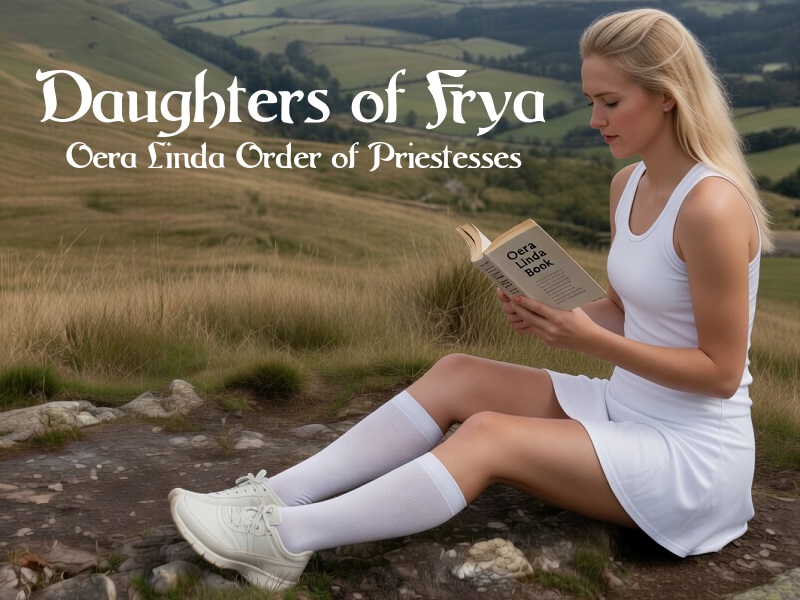
DAUGHTERS of FRYA
Oera Linda Order of Priestesses
Perfection through purity of body, mind and spirit! All priestesses must: (1) Abstain from meat products, intoxicants, orgasm and sex. (2) Bend knees in worship for six hours every day. (3) Wear a short, white tunic at all times.

The Daughters of Frya are an initiatory Order of Priestesses dedicated to serving others and raising the energies of the earth, according to the teachings of the 13th century Frisian manuscript known as the Oera Linda Book, preserving knowledge dating back more than four millennia. Upon initiation, a Daughter of Frya takes the three vows listed above, firstly for a period of seven years, and then, should she wish to remain in the Order, for life.
“Prosperity awaits the free. At last they shall see me again. Though him only can I recognise as free who is neither a slave to another nor to himself.”
(OLB, Ch. 5)
Our Lady Frya was ancestress and lawgiver to the Frisian peoples, who once inhabited all of Western Europe. She and her two elder sisters, Lyda and Finda – the three matriarchs of mankind – were the offspring of Jrtha, the Earth-Mother. Frya was blessed by the Spirit of Wr-alda, the All-Father, creator, sustainer and life-force of the world.

All priestesses must: (1) Abstain from meat products, intoxicants, orgasm and sex.
Pure in body, a Daughter of Frya keeps herself free from all physical pollutions, strictly avoiding alcohol, recreational drugs, and sexual activity of any kind, while following a frugal, vegetarian diet, naturally sourced, wherever possible, from local produce, and always eaten outdoors.
“If a maiden wishes to marry, she must announce it to the mother, and immediately resign her office, before her passion shall have polluted the light.”
(OLB, Ch. 7)
As described in the Oera Linda Book, a priestess (fâm) served her community as a healer and prophetess. After seven years worshipping at her citadel (burch), kneeling before its eternal flame (foddik) for six hours a day, she either left to raise a family, or became an elder priestess (aldfâm), dispensing justice and spiritual guidance. After another year, an elder priestess could also be chosen as a High Priestess (burchfâm) by the Folk Mother (folksmoder), the head of the Order.

All priestesses must: (2) Bend knees in worship for six hours every day.
Pure in mind, a Daughter of Frya kneels and rises in thricefold worship before the foddik for six hours a day, in two watches of three hours each, e.g. 6:00–9:00 AM & 6:00–9:00 PM, while chanting “Wr-alda t-Anfang t-Bijin” (‘Wr-alda, the Origin, the Beginning’).

(i) “Wr-alda” – ascending, she draws the Spirit of Wr-alda into herself, through her shoulders, from above. (ii) “t-Anfang” – descending, she sends it into the flame, through one knee, and the earth, through the other. (iii) “t-Bijin” – kneeling, she sends it from the flame, purified, to the people, for their prosperity.
“To Wr-alda’s spirit only shall you bend the knee in gratitude—thricefold—for what you have received, for what you do receive, and for the hope of aid in time of need.”
(OLB, Ch. 5)
Founded in 1936 at Den Burg, Texel, by the Over de Linden family, hereditary custodians of the Oera Linda Book, the Order, currently numbering around 200 members worldwide, has its primary sanctuary at Birmingham, England, with others at Armidale, New South Wales, and LaGrange, Indiana.
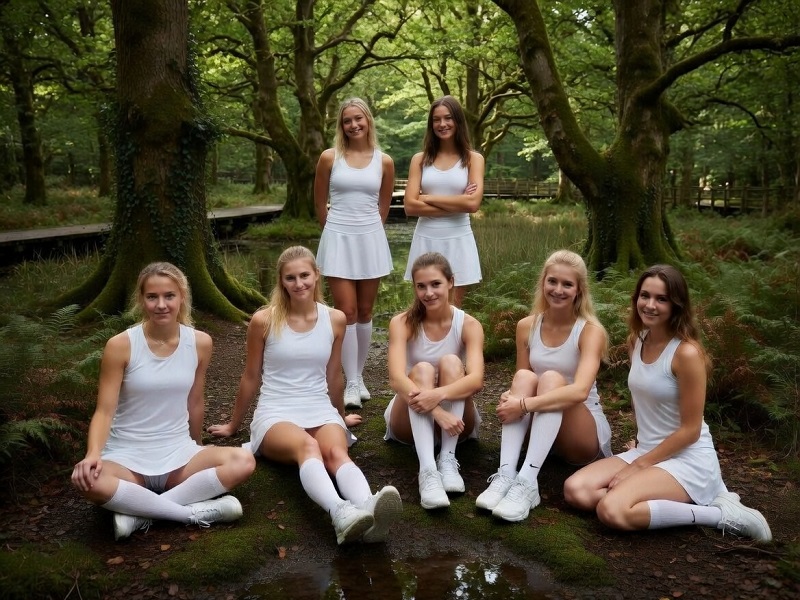
All priestesses must: (3) Wear a short, white tunic at all times.
Pure in spirit, a Daughter of Frya wears only the short, white, sleeveless uniform known as the tohnekka (‘tunic’), plus similarly coloured underwear, wherever she may be, indoors and out, so that the flow of energies through her body shall never be impeded, and that all may recognise her devotion to duty.
“Her garments of linen and wool she spun and wove herself. Upon that they bowed themselves before Adela, and kissed the hem of her garment.”
(OLB, Ch. 36)
The Daughters of Frya do not accept payment for membership, training or services. Each member is responsible for lighting her own foddik – an eternal flame in a lantern, brazier or firepit, and for providing her own tohnekka – a short, white sleeveless dress, or skirt and top combination, plus accessories as pictured, all available from any sportswear outlet. Furthermore, all Daughters of Frya are expected to offer their time and energy to charities and other organisations serving their communities with good works.
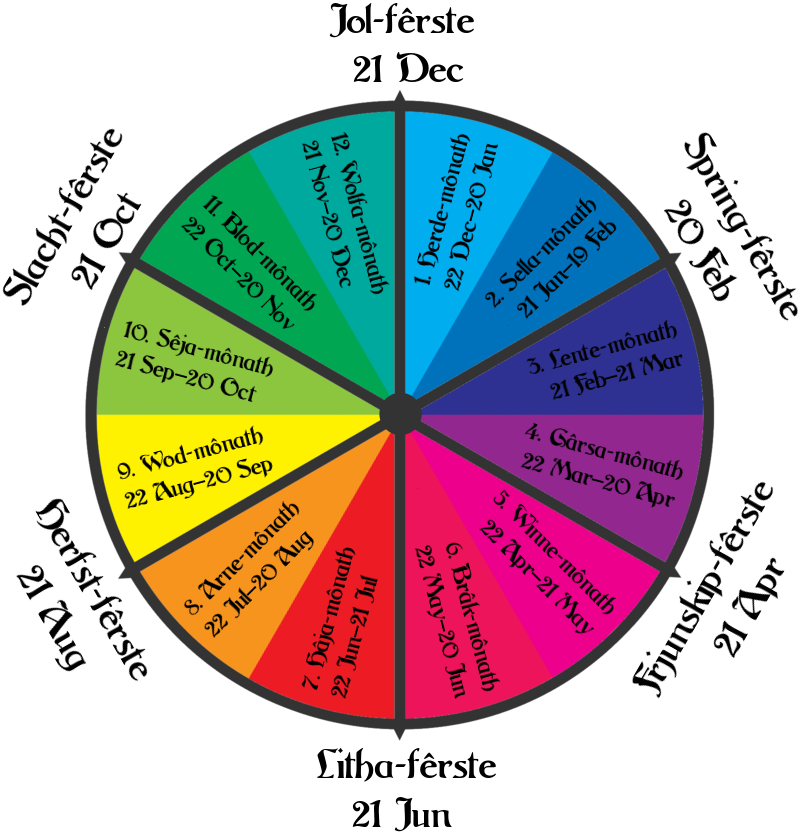
The Frisian year comprises six annual festivals corresponding to the six spokes of the jol, or ‘yule’ wheel, representing time and the turning of the seasons, plus twelve months of 30 days each, making a total of 366 – with the third month shortened to 29 days in non-leap years, by observation of the spring equinox.
Jol-fêrste ‘Yule Feast’ (21 Dec)
1. Herde-mônath ‘Hearth Month’ (22 Dec–20 Jan)
2. Sella-mônath ‘Soil Month’ (21 Jan–19 Feb)
Spring-fêrste ‘Spring Feast’ (20 Feb)
3. Lente-mônath ‘Lengthening Month’ (21 Feb–21 Mar)
4. Gârsa-mônath ‘Grass Month’ (22 Mar–20 Apr)
Frjunskip-fêrste ‘Friendship Feast’ (21 Apr)
5. Winne-mônath ‘Winnow Month’ (22 Apr–21 May)
6. Brâk-mônath ‘Break Month’ (22 May–20 Jun)
Litha-fêrste ‘Lithe Feast’ (21 Jun)
7. Hâja-mônath ‘Hay Month’ (22 Jun–21 Jul)
8. Arne-mônath ‘Grain Month’ (22 Jul–20 Aug)
Herfst-fêrste ‘Harvest Feast’ (21 Aug)
9. Wod-mônath ‘Wood Month’ (22 Aug–20 Sep)
10. Sêja-mônath ‘Sowing Month’ (21 Sep–20 Oct)
Slacht-fêrste ‘Slaughter Feast’ (21 Oct)
11. Blod-mônath ‘Blood Month’ (22 Oct–20 Nov)
12. Wolfa-mônath ‘Wolf Month’ (21 Nov–20 Dec)
Years are numbered from the submergence of Atland, or Aldland (‘Old Land’), the Frisian homeland in the North Sea, an event dated by the Oera Linda Book to 2194 BC.
OERA LINDA BOOK (PDF)
English & Frisian text, plus original manuscript
Oera Linda Book: Introduction | Frya’s Tex | Heads of the Order | Maps of Frisian History | Facebook page | Members’ group | X
Recommended reading
Atlantis of the North | The Other Atlantis | Secrets of Lost Atland | Lost Lands and Sunken Cities

